Featured Local Provider
Zelica Waterproof & Encapsulation
Asheville, Buncombe County and surrounding Western North Carolina
Home Problems Guide selected Zelica Waterproof & Encapsulation as a useful first contact for this guide after reviewing current public evidence of exact-service capability and local market fit. Featured status is editorial, not a guarantee of project fit.
Understand the Problem
What crawl space moisture problems look like in Buncombe County
Homeowners searching for crawl space encapsulation or crawl space moisture repair in Asheville, Buncombe County, Black Mountain, Weaverville, Candler, Fairview, Leicester, Swannanoa, Woodfin, Arden, Fletcher often notice musty indoor air, high humidity, condensation on ducts or joists, visible mold growth, standing water or damp soil under the house, soft or sagging floors, or insulation that is wet or falling.
This page does not diagnose crawl-space failure or mold severity. Similar symptoms can come from plumbing leaks, roof or flashing issues, poor exterior grading, or HVAC problems. An on-site evaluation is required.
Buncombe County / Asheville Rules & Repair Options
Buncombe County / Asheville permit jurisdiction and closed-crawl rules
North Carolina OSFM currently lists the 2018 Residential Code as the effective residential code. OSFM’s December 11, 2025 interpretation says converting a conventional vented crawl space to a closed crawl space under Section R409 requires a permit because the required moisture-control methods involve mechanical or electrical changes. Buncombe County Permits & Inspections serves unincorporated Buncombe County and, by contract, Biltmore Forest, Weaverville and Woodfin. City of Asheville projects use City permitting jurisdiction, while Black Mountain has its own inspection department. Confirm the property jurisdiction before work begins.
What a closed-crawl conversion changes
The current North Carolina closed-crawl framework is more than laying plastic over dirt. Section R409 addresses ground-vapor control and requires an approved moisture-control method. OSFM identifies methods that can include a permanently installed dehumidifier, supply air, house air, exhaust or designing the crawl as conditioned space. The exact mechanical/electrical scope affects permits, inspections and trade-credential requirements.
Encapsulation versus simpler vapor barrier approaches
On many Buncombe County mountain homes, encapsulation is the most common permanent solution when humidity, open dirt floors, and recurring water combine. Simpler vapor barriers or limited venting changes may be discussed for milder conditions, but chronic moisture often needs a sealed liner, drainage and sump components when water is present, insulation strategy, and dehumidification.
| Project path | When it may be discussed |
|---|---|
| Limited vapor barrier / cleanup | Minor dampness without structural damage, after exterior water sources are controlled. |
| Drainage + sump under the house | Standing water or seasonal seepage enters the crawl space. |
| Full encapsulation | Chronic humidity, mold risk, and open dirt floors call for a sealed system with dehumidifier support. |
| Encapsulation + structural repair | Joists, sills, or beams show rot or deflection that must be addressed with the moisture work. |
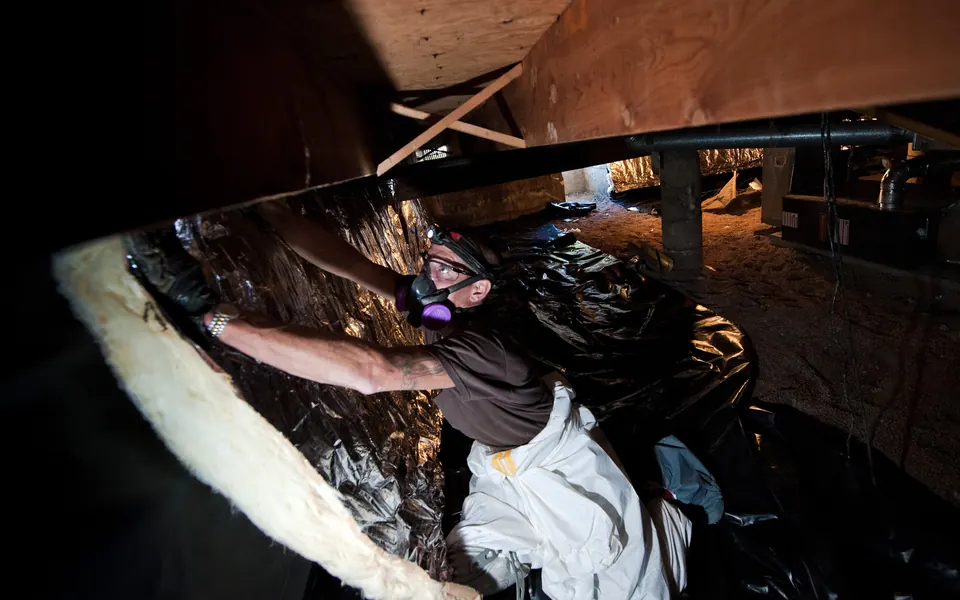
Local construction and soil conditions in Buncombe County
Older homes frequently use pier-and-beam or traditional crawl-space construction over dirt floors. Combination of high humidity + clay-rich residual soils + missing vapor barrier produces: chronic moisture → mold → wood rot in joists/sills → sagging floors → indoor air concerns. Encapsulation is the most common permanent solution.
Western North Carolina mountain soils are predominantly residual soils formed from weathering of gneiss, schist, and granite. Soft saprolite is common at depth. Surface layers are frequently clay-rich. These clays expand when wet and shrink when dry. Common series include Evard, Burton, Tate, Clifton, Cowee, Wayah, Cullasaja, Haywood and related series. Many are mapped as well-drained but become problematic when compacted or when drainage is blocked.
The same soil that looks stable in dry weather generates large hydrostatic and swelling pressure against retaining walls and holds moisture under homes. Clay-rich residual soils under a dirt crawl floor, high regional humidity, and steep lots that push water toward the foundation commonly reinforce the need for sealed moisture control rather than open-vent crawl designs alone.
How to move forward
1. Record what you can observe
Note musty air, visible moisture, standing water, insulation condition, and any floor soft spots—without assuming a single cause.
2. Separate exterior water from under-house moisture
Poor grading and clay soils often feed crawl-space wetness; note downspouts, slopes, and roof runoff.
3. Compare local providers
Use the independent directory to review providers that publicly advertise relevant work, then contact candidates directly for evaluation or estimates.
Cost
Current planning benchmarks
| Scope | Planning benchmark |
|---|---|
| Vapor barrier / limited moisture-control scope | $1,500–$4,000 |
| Complete encapsulation sizing baseline | $3–$7 per crawl-space sq ft |
| Western NC mountain-region standard-project cross-check | $5,000–$8,000 |
| Higher-complexity professional envelope | Up to about $10 per sq ft |
These are planning benchmarks assembled from current North Carolina contractor guidance, a Western North Carolina regional cost cross-check and an independent consumer cost guide. They are not Zelica Waterproof & Encapsulation prices and are not a substitute for an onsite estimate.
Worked floor-area examples
| Planning floor area | $3–$7/sq-ft baseline |
|---|---|
| 1,000 sq ft | $3,000–$7,000 |
| 1,500 sq ft | $4,500–$10,500 |
| 2,000 sq ft | $6,000–$14,000 |
These examples are baseline sizing math only. They exclude unresolved bulk-water entry, difficult access, major structural wood repair, remediation and other site-specific work.
Common add-ons and scope drivers
| Cost driver | Current planning context |
|---|---|
| Drainage / sump scope when active water is present | About $1,500–$3,000 added in current NC guidance |
| Installed commercial-grade dehumidifier | About $3,000–$5,000 added in current NC guidance |
| Structural wood repair | Price separately from moisture control when joists, sills, beams or supports are damaged. |
| Access, debris, old insulation, piers and penetrations | Can materially change labor and membrane detailing even at the same floor area. |
Evidence reviewed August 16, 2026. Planning inputs: Peak Energy NC 2026 cost guide, Western NC regional cross-check, and The Spruce independent range. Compare written scopes rather than choosing from a headline price alone.
Find & Compare Contractors
Comparison providers serving Buncombe County / Asheville
The Featured Local Provider above is an unpaid editorial selection. The businesses below are neutral comparison starting points and are not ranked or endorsed. Confirm current service area, relevant credentials, insurance and exact crawl-space scope directly.
’58 Foundations
Public materials cover foundation and crawl-space related residential services in regional markets.
Asheville Moisture Control
Public materials focus on moisture-related crawl-space and indoor-moisture control work in the Asheville area.
Foundation and Crawl Space Pros
Public materials describe foundation and crawl-space evaluation and repair-related services.
All-Dry / Basement Systems
Public materials describe basement and crawl-space waterproofing and moisture-control systems under regional branding.
Groundworks / Mount Valley
Public materials describe foundation, crawl-space, and related structural moisture services across regional markets.
Precision Restoration
Public materials describe restoration and moisture-related repair services for residential properties.
CNT Foundations
Public materials list foundation and crawl-space related residential services.
Local encapsulation crews
Smaller local encapsulation and moisture-control companies also serve Western North Carolina markets. Confirm current licensing, insurance, and service territory directly.
Foundation Solutions
Public materials describe foundation and structural repair services that may include crawl-space related work.
Civil & Home Solutions
Public materials describe residential structural and moisture-related services in regional markets.
Business information can change. Send a factual correction through the contact page. Home Problems Guide does not recommend, endorse, or screen any provider.
Compare the scope, not just the total
| Ask each estimator | Why it matters |
|---|---|
| What is the measured crawl-space floor area and what surfaces will the liner cover? | Clarifies whether square-foot pricing is based on floor area, actual membrane area or a bundled system. |
| What bulk-water source is being corrected? | Separates drainage, sump or grading work from vapor and humidity control. |
| Which R409 moisture-control method is included? | Clarifies dehumidifier, supply-air or other mechanical/electrical scope and helps define permit responsibility. |
| What is excluded? | Old insulation, remediation, rotten wood, electrical work, sump discharge and exterior drainage may be separate. |
| Who obtains the permit and coordinates inspections? | A closed-crawl conversion has a current NC permit requirement; responsibility should be explicit in writing. |
| What warranty applies to liner, drainage and equipment? | Different system components can have different warranty terms and maintenance requirements. |
Frequently Asked Questions
Does musty air mean I need encapsulation in Asheville?
Not automatically. Musty air in Asheville and Buncombe County homes can come from crawl-space moisture, plumbing leaks, or other sources. Encapsulation is a common permanent solution for chronic crawl moisture, but only on-site evaluation can determine the right path.
Why are crawl spaces so damp in Buncombe County?
Older homes frequently use pier-and-beam or traditional crawl construction over dirt floors. High humidity, clay-rich residual soils, and missing vapor barriers produce chronic moisture, mold risk, wood rot, sagging floors, and indoor air concerns.
What is the difference between a vapor barrier and encapsulation?
A simpler vapor barrier may be discussed for milder conditions. Full encapsulation typically seals the crawl space with a liner system and often includes dehumidification and drainage components when water is present.
What does crawl space encapsulation cost in Buncombe County?
Current North Carolina planning evidence puts complete encapsulation around $3–$7 per crawl-space square foot, with a Western North Carolina regional cross-check around $5,000–$8,000 for many standard projects. Drainage, sump, dehumidifier, access, structural wood repair and remediation can materially change the total. These are planning ranges, not Zelica Waterproof & Encapsulation prices.
Can sagging floors be related to the crawl space?
Yes. Chronic moisture can lead to wood rot in joists and sills and contribute to sagging floors. Structural assessment may be needed along with moisture repair.
Does this site diagnose mold from a webpage?
No. Home Problems Guide never diagnoses mold severity or structural failure from a webpage.
How should I use the provider directory?
No. Home Problems Guide does not currently collect project requests on this page. Contact providers directly using the directory.
Are listed companies endorsed?
No. Home Problems Guide does not recommend, endorse, rank, or screen any provider.
Helpful official and practical sources
NC OSFM current building codes
Confirms the currently effective North Carolina code editions, including the 2018 Residential Code.
Official resource ↗OSFM closed-crawl permit interpretation
Current state interpretation explaining why a conventional-to-closed crawl conversion under R409 requires a permit.
Official resource ↗Buncombe County Permits & Inspections
Current county permit jurisdiction, permit triggers, forms and inspection contacts.
Official resource ↗EPA moisture-control guidance
Federal guidance on source control and moisture-related building problems.
Official resource ↗