Featured Local Provider
Mountain Drainage Solutions
Asheville and surrounding Buncombe County communities
Home Problems Guide selected Mountain Drainage Solutions as a useful first contact after rechecking current first-party evidence for French drains, buried drainage, dry wells and other rainwater-management work in Asheville and surrounding areas. Featured status is editorial, not a guarantee of project fit.
Understand the Problem
What yard drainage problems look like in Buncombe County and Asheville
Homeowners searching for French drain installation in Asheville or yard drainage problems in Asheville, Buncombe County, Black Mountain, Weaverville, Candler, Fairview, Leicester, Swannanoa, Woodfin, Arden, and Fletcher often see standing water after rain, soggy lawns that stay wet, water flowing toward the foundation, erosion channels on slopes, wet basements or crawl spaces after storms, or washouts along driveways and retaining walls.
This page does not diagnose the drainage failure mode. Roof runoff, clogged gutters, broken pipes, high water table, or blocked daylight outlets can all produce similar symptoms. Site evaluation is required.
Buncombe County / Asheville Rules & Repair Options
Buncombe County and Asheville drainage review checkpoints
Start with jurisdiction. City of Asheville is a separate permitting jurisdiction. A drainage project inside Asheville uses the City's stormwater, grading and flood review process; do not apply Buncombe County's one-acre threshold as a City rule.
| Current checkpoint | Why it matters |
|---|---|
| Unincorporated Buncombe County stormwater | Residential development disturbing one acre or more requires County stormwater permitting. An existing subdivision stormwater permit can also affect how runoff may be directed on an individual lot. |
| County erosion control | Land disturbance of one acre or more requires an erosion-control permit; within a defined Hillside Subdivision, the published threshold is 1/4 acre or more. Below those thresholds, erosion and sediment still must be controlled. |
| Floodplain | Grading, filling or other man-made change in the regulated 100-year floodplain generally requires floodplain review and a development permit. |
| Streams / rights-of-way | Work in a stream can require separate federal/state approvals. Work in an NCDOT right-of-way can require an encroachment agreement and other approvals. |
| City of Asheville | Use the City's separate stormwater/grading/flood process and confirm the exact requirements with DSD before excavation. |
Not every shallow residential French drain automatically needs the same permit path. The correct review depends on jurisdiction, disturbance area, floodplain/stream/right-of-way involvement, and the actual work proposed.
French drain versus regrading
The right project path depends on where the water originates, whether the lot has usable fall to a safe outlet, and whether the problem is primarily surface runoff, subsurface water, roof discharge, or a combination. Regrading may solve some sites; other sites need a French drain, catch basin, buried downspout line, dry well, or combined system.
| Project path | When it may be discussed |
|---|---|
| Surface regrading and downspout routing | Water can be redirected with swales, slope corrections, and roof-water management. |
| French drain / subsurface drain | Water stays in the soil profile or moves below grade toward the house despite surface fixes. |
| Combined grading + drain system | Steep lots need both surface control and a daylighted or sump-connected subsurface system. |
| Wall or foundation drainage integration | Retaining walls or basements share the same hydrostatic load and need coordinated design. |
Project scope varies with the water source, outlet, excavation depth, access, grading and restoration. Current numerical planning evidence is grouped in the dedicated Cost section below.
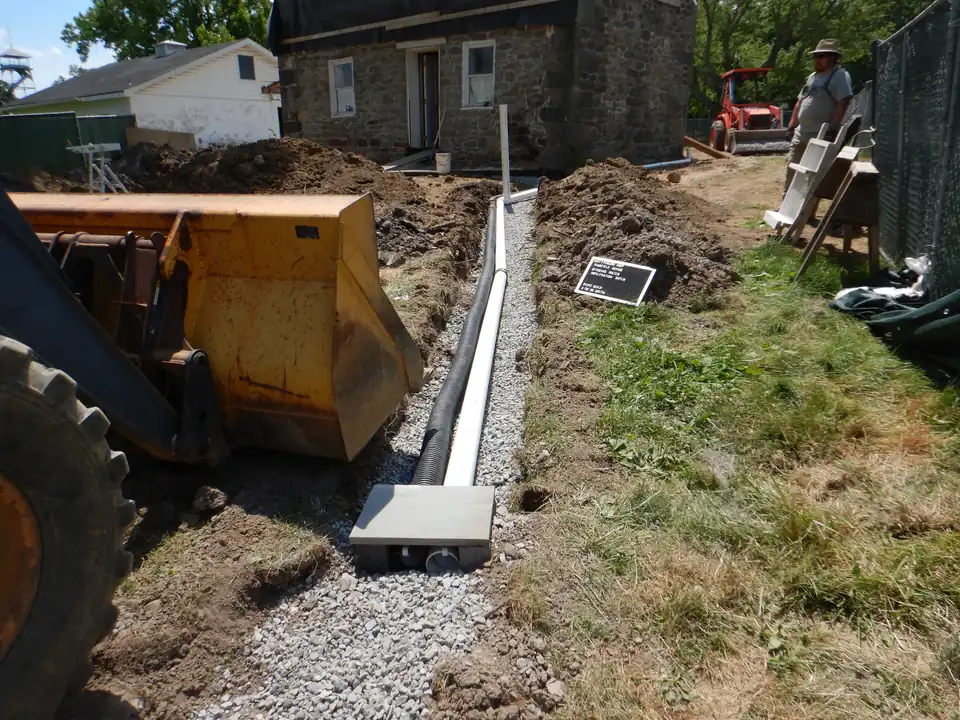
Local clay soils and steep grades in Buncombe County
Clay-rich mountain soils and steep grades can concentrate runoff and slow infiltration, but they do not automatically mean a French drain is the correct solution. The drainage path should match the observed water source, outlet, slope, and property constraints.
Western North Carolina mountain soils are predominantly residual soils formed from weathering of gneiss, schist, and granite. Soft saprolite is common at depth. Surface layers are frequently clay-rich. These clays expand when wet and shrink when dry. Common series include Evard, Burton, Tate, Clifton, Cowee, Wayah, Cullasaja, Haywood and related series. Many are mapped as well-drained but become problematic when compacted or when drainage is blocked.
The same soil that looks stable in dry weather generates large hydrostatic and swelling pressure against retaining walls and holds moisture under homes. On Asheville-area and mountain properties, blocked or missing drainage quickly turns residual clay into a long-lasting wet zone against foundations and walls.
How to move forward
1. Record what you can observe
Note where water ponds, how it moves toward the house, downspout discharge, and any wet crawl space or basement after rain.
2. Consider surface and subsurface options
Regrading may help, but clay soils and steep grades often also need French drains.
3. Compare local providers
Use the independent directory to review providers that publicly advertise relevant work, then contact candidates directly for evaluation or estimates.
Cost
Yard drainage is not one price category. A shallow French drain, buried downspout line, swale, dry well and deep footing/perimeter drain solve different water problems and require different excavation. The ranges below are current 2026 planning evidence, not a diagnosis or quote.
| Planning scope | Current planning range | How to use it |
|---|---|---|
| Shallow exterior / yard French drain | $10–$35 per linear foot | 2026 planning range for common shallow exterior French/curtain drain work. |
| Underground downspout drainage | $15–$35 per linear foot | Broad 2026 context for buried roof-water routing; crossings and outlets can change cost. |
| Swale / grading-based drainage | $5–$15 per linear foot | Broad unit context; HomeGuide also places yard regrading around $500–$5,000 depending on scope. |
| Dry well | $50–$3,000+ | Varies sharply by gravel versus prefabricated/concrete system, depth and site conditions. |
| Deep exterior perimeter / weeping drain | $30–$90 per linear foot | Do not compare this directly with a shallow yard French drain; footing-depth excavation is a different project. |
Worked shallow-yard-drain arithmetic
| Illustrative shallow drain length | 2026 unit context | Arithmetic-only range |
|---|---|---|
| 50 linear feet | $10–$35 per linear foot | $500–$1,750 |
| 100 linear feet | $10–$35 per linear foot | $1,000–$3,500 |
| 150 linear feet | $10–$35 per linear foot | $1,500–$5,250 |
What can move a Buncombe County / Asheville drainage quote
| Cost driver | Why it matters |
|---|---|
| Water source and system type | Roof runoff, surface ponding and subsurface water may require different systems or combinations. |
| Outlet and available fall | Gravity daylight, dry well, approved storm connection or pump-assisted discharge can change the design. |
| Depth, slope and access | Mountain terrain, deep excavation, rock, tight machine access and long hauling paths increase labor. |
| Utilities and crossings | 811 coordination plus sidewalks, driveways, patios, retaining walls and landscaping can complicate routing. |
| Grading / regulatory scope | Land-disturbance, floodplain, stream, right-of-way or City stormwater/grading review can add design and administrative work. |
| Restoration | Backfill, finish grading, seed/sod, hardscape repair and landscape replacement can be significant. |
Planning evidence reviewed August 17, 2026. Current 2026 HomeGuide French-drain and drainage-system data provide the primary unit ranges, cross-checked against current Angi French-drain and yard-drainage data. These are independent planning figures, not Mountain Drainage Solutions prices. No calculator is shown because length alone cannot determine the correct drainage system, outlet, excavation depth, grading or regulatory scope.
Find & Compare Contractors
Match the contractor to the actual water-management problem
| Possible need | What to verify |
|---|---|
| Yard / French-drain specialist | Exact experience with the proposed drain type, outlet strategy, buried piping, catch basins or dry wells. |
| Grading / excavation contractor | Whether grading, swales, machine excavation and restoration are part of the written scope. |
| Foundation / waterproofing specialist | Use when the drainage problem is tied to basement, crawl-space, footing or structural water intrusion rather than yard drainage alone. |
| Engineer / landscape architect | Consider when site constraints, stormwater design, slopes, retaining structures, floodplain issues or required sealed plans make professional design appropriate. |
Local provider comparison options
Backwoods Grading
Public materials list grading and excavation services relevant to yard drainage and French-drain site work.
Thorpe Landscapes
Public materials describe landscaping and hardscape services that may include drainage-related outdoor work.
Greenspan Landscaping
Public materials describe landscaping services for residential outdoor drainage and site improvements.
WNC Concrete Contractors
Public materials list concrete and site-related contracting that may support drainage structures.
E.K. Construction
Public materials describe construction and site work relevant to grading and drainage projects.
Terra Builders AVL
Public materials describe building and site construction for Asheville-area properties.
Tuff Walls / 828 Tuff Walls
Public materials focus on structural walls; drainage behind walls is a common related scope on hillside properties.
DryWorx Asheville
Public materials describe waterproofing services that may include exterior drainage components.
All-Dry / Basement Systems
Public materials describe waterproofing and exterior drainage-related systems for residential properties.
Civil & Home Solutions
Public materials describe residential water-management and structural moisture services.
Business information can change. Send a factual correction through the contact page. Home Problems Guide does not recommend, endorse, or screen any provider.
Questions to put on every drainage estimate
- What observed water source is the proposed system intended to control?
- Why is a French drain, grading change, buried downspout, catch basin, dry well, or combined system the preferred approach?
- Where will collected water discharge, and is there adequate fall or a pump requirement?
- What drain depth, pipe/material specification, fabric, stone and cleanout access are included?
- Who contacts 811 and verifies utility clearance before excavation?
- Does the property fall inside Asheville, unincorporated Buncombe County, a floodplain, a hillside subdivision, a subdivision stormwater plan, a stream area, or a public right-of-way that changes the review path?
- Are excavation, hauling, backfill, finish grading, seed/sod and hardscape/landscape restoration included?
- What happens if excavation finds rock, unsuitable outlet conditions, or a different water source than expected?
- What workmanship or installed-system warranty is included in writing?
Frequently Asked Questions
Will regrading alone fix standing water in Asheville?
Not always. The correct approach depends on the water source, grade, outlet, soil, and site constraints. Surface grading, roof-water routing, subsurface drainage, or a combination may be appropriate after onsite evaluation.
What is a French drain used for in Buncombe County?
A French drain is a subsurface drainage system used to collect and move water that stays in the soil profile or flows below grade—common on clay-rich mountain lots around Asheville.
How much does a French drain cost in Asheville?
Current 2026 planning data puts shallow exterior or yard French drains around $10–$35 per linear foot. That makes 50 linear feet about $500–$1,750, 100 feet about $1,000–$3,500, and 150 feet about $1,500–$5,250 in arithmetic-only planning terms before system-specific add-ons. Deeper exterior perimeter drainage, grading, dry wells, access, restoration, pumps, and permit or engineering scope can change the total.
Can poor yard drainage affect my foundation or crawl space?
Yes. Water directed at the house on clay soils can contribute to crawl-space moisture, basement seepage, and soil pressure against walls.
Does standing water after one storm mean I need a French drain?
Not necessarily. One storm can overwhelm any yard. Recurring ponding, soft ground, and water against the foundation warrant evaluation—not a remote diagnosis.
Do I need permits for drainage work in Buncombe County?
Not every shallow residential French drain follows the same permit path. In unincorporated Buncombe County, stormwater or erosion-control review can be triggered by larger land disturbance, hillside-subdivision thresholds, floodplain work, streams, rights-of-way, or an existing subdivision stormwater plan. City of Asheville properties use the City’s separate stormwater, grading, and flood review process. Confirm jurisdiction and project scope before excavation.
How should I use the provider directory?
Use the listings as research starting points. Contact providers directly, compare written scopes, and verify current service territory, insurance, credentials where applicable, permitting responsibility, and project fit.
Are listed companies endorsed?
No. The Featured Local Provider is an unpaid editorial selection based on current public evidence, and the remaining comparison listings are neutral research starting points. Home Problems Guide does not guarantee project fit.
Want to learn more?
Buncombe County — Stormwater Management
Check current County stormwater thresholds, subdivision requirements, contacts and submittal guidance.
Buncombe County — Erosion Control
Review current land-disturbance thresholds and erosion/sedimentation responsibilities.
Buncombe County — Floodplain Development
Check whether grading, filling or drainage work lies within a regulated floodplain.
City of Asheville — Development Services
Use the City's separate permit, stormwater, grading and flood resources for properties inside Asheville.
HomeGuide — 2026 French Drain Cost
Current national planning context for shallow yard drains, deep perimeter drainage, dry wells and grading.
Angi — 2026 Yard Drainage Cost
Current cross-check for French drains, swales and broader yard-drainage project costs.