Featured Local Provider
ABC Quick Pump Septic Service & Rentals
Northwest Arkansas — Benton & Washington Counties
Home Problems Guide selected ABC Quick Pump for this initial feature after reviewing current public evidence of Northwest Arkansas operation and published services that include inspections, pump outs, repairs and new system installs. The feature is a starting point for homeowner verification—not a guarantee that the company or a particular repair is right for every property.
Understand the Problem
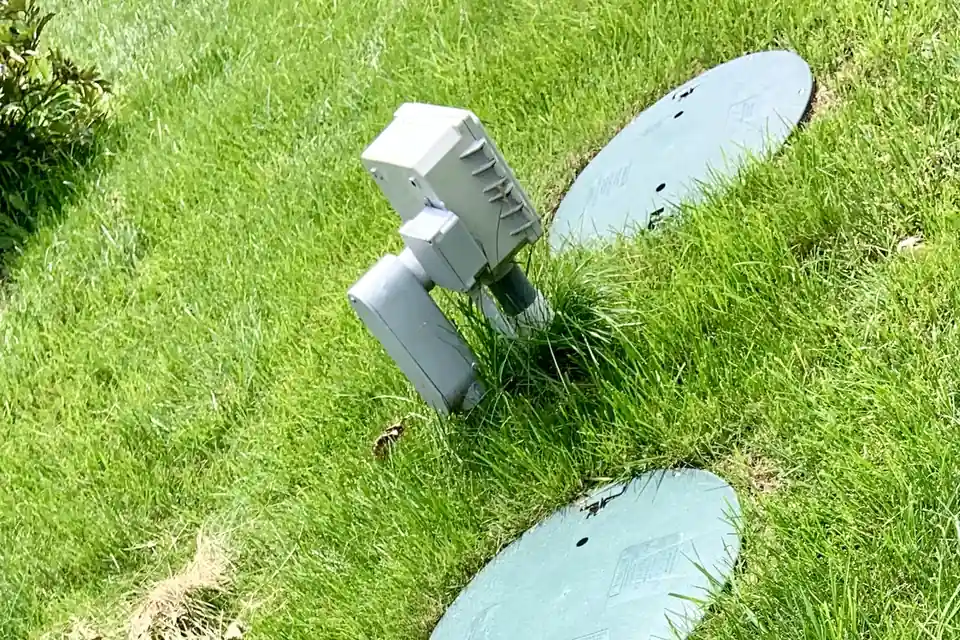
First confirm the property actually uses an onsite system
A Bentonville, Rogers or Benton County address does not by itself prove the property uses septic. Rapid Northwest Arkansas growth includes sewered development as well as rural and exurban onsite systems. Confirm wastewater service and look for existing permit records before treating a backup or wet yard as a drain-field failure.
Warning signs worth documenting without diagnosing the cause
What else can cause similar symptoms?
EPA notes that septic malfunctions can involve maintenance, unsuitable design/site conditions or system components. An onsite evaluation may need to distinguish among a tank that needs service, plumbing or piping trouble, baffle or distribution issues, pump/control failure, tank damage, field-line damage and drain-field failure. Do not authorize full replacement based on one symptom alone.
Benton County Rules & Repair Options
Repair a component, repair the field, replace the field—or replace more?
| Project path | When it may enter the discussion |
|---|---|
| Component or line repair | A pipe, baffle, distribution component, pump/control or tank component is the primary failure and a compliant repair addresses it. |
| Field-line or partial field work | A defined portion of the absorption system can be corrected and the proposed work fits the site's evaluation and approved design. |
| Drain-field replacement | The existing absorption area no longer functions reliably and a suitable approved replacement solution is available. |
| Alternative or advanced system work | Site constraints, system type or treatment method require a different design, added controls or additional professional input. |
| Full system replacement | Multiple components, tank condition, site limitations or the approved redesign make broader replacement the practical path. |
The useful estimate question is not simply “How much is a new septic system?” Ask what evidence supports the proposed scope, what can remain, what must change, and which design, permitting, inspection and restoration steps are included.
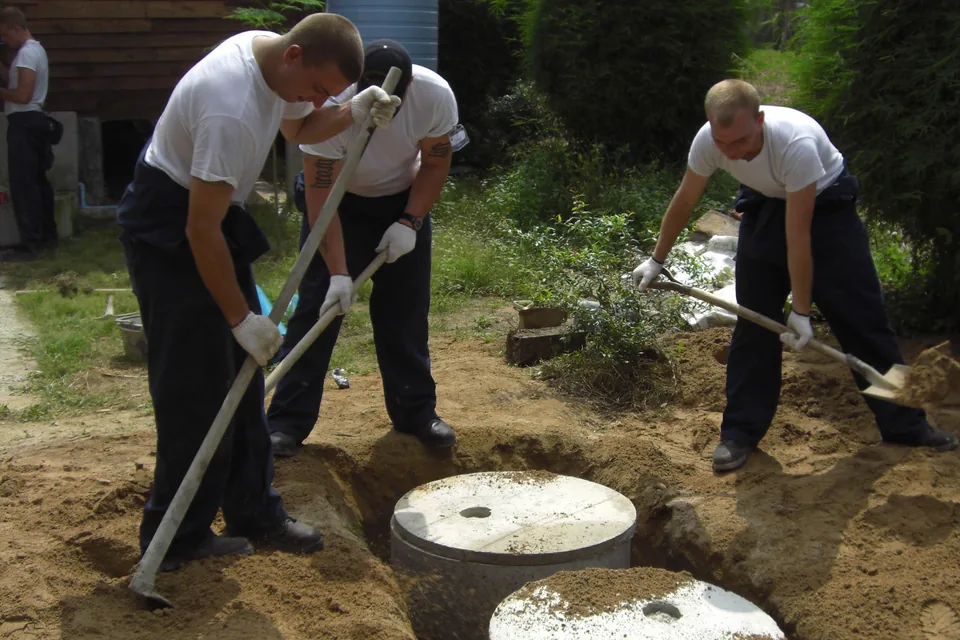
How Arkansas and Benton County roles affect the project
The Arkansas Department of Health's Onsite Wastewater program sets statewide policy and reviews onsite-wastewater permit applications with local Environmental Health Specialists. ADH's current FAQ directs homeowners seeking a septic permit to the county health unit's Onsite Environmental Specialist, who can provide licensed professionals for soil testing and system design.
Benton County Planning separately states that ADH regulates, inspects and issues permits for septic systems and wells. Benton County Building Safety handles local building, electrical, plumbing and mechanical matters in unincorporated areas and says it may require a copy of the approved septic permit or septic verification for plumbing permits. These are related processes, not interchangeable authorities.
Public sewer versus onsite wastewater
This page is for Benton County properties that use or are evaluating onsite wastewater. It should not be read as a claim that Bentonville or Rogers homes generally use septic. Before spending money on replacement design, confirm whether the property is already connected to public sewer or whether sewer availability affects the project.
Cost
Major septic work is not one price category. In Benton County, the failed component, existing records, site/soil evaluation, available replacement area, conventional versus advanced design, access, excavation, ADH requirements and restoration can all change the scope. These ranges are planning evidence, not a diagnosis or quote.
| Planning scope | Current planning range | How to use it |
|---|---|---|
| Distribution-box replacement context | $500–$1,500 | 2026 component benchmark; not a drain-field replacement price. |
| Drain-field repair / rejuvenation | $1,000–$5,000 | 2026 planning band when the approved solution is repair rather than replacement. |
| Tank replacement context | $3,000–$5,000 | 2026 national planning context for tank replacement alone; the field and permit/design scope can be separate. |
| Conventional drain-field replacement | $3,000–$15,000 | 2026 field-replacement planning band before property-specific evaluation, access and restoration. |
| Tank + field broad project context | $4,500–$20,000 | Broad current planning range when the project extends beyond a field-only repair. |
| Mound drain-field replacement context | $10,000–$20,000 | 2026 planning band for this more complex field type; it is not an automatic Benton County requirement. |
Worked field-line arithmetic
Current 2026 planning evidence places field-line replacement around $20–$45 per linear foot. If an approved repair actually involved 100 linear feet of field line, that arithmetic is about $2,000–$4,500; 150 linear feet is about $3,000–$6,750. These examples do not determine how much field line a property needs and do not include every design, tank, excavation, permit, testing or restoration cost.
| Illustrative approved field-line scope | 2026 unit context | Arithmetic only |
|---|---|---|
| 100 linear feet | $20–$45 per linear foot | $2,000–$4,500 |
| 150 linear feet | $20–$45 per linear foot | $3,000–$6,750 |
What can move a Benton County quote
| Cost driver | Why it matters |
|---|---|
| What actually failed | A distribution component, pump or line repair is fundamentally different from replacing the tank, absorption field or full system. |
| Existing records and usable replacement area | System layout, design flow, setbacks and available approved area can change the repair or replacement path. |
| Site/soil evaluation and design | The approved design may depend on site and soil conditions, bedroom/design flow and the system type the property can support. |
| Advanced or pumped system components | Pumps, controls, electrical work or a more complex treatment/distribution design can add cost. |
| Access, excavation and restoration | Rock, trees, utilities, hardscape, hauling, grading and finish restoration can materially change construction cost. |
Planning evidence reviewed August 17, 2026. The component, field, tank, field-line and broader system ranges are cross-checked against current 2026 HomeGuide planning data. They are independent planning figures, not ABC Quick Pump Septic Service & Rentals prices. No calculator is shown because homeowner-entered dimensions cannot determine the approved septic repair or system design.
Find & Compare Contractors
Match the provider to the work—not just the word “septic”
| Need | What to verify |
|---|---|
| Routine pumping / tank service | Current cleaner/pumper credentials and service fit. |
| Major repair or drain-field work | Current Arkansas onsite-wastewater installer credential for the work, exact repair/drain-field capability, excavation scope and territory. |
| Full or alternative-system replacement | Installation capability, design/evaluation role, approved system scope and who coordinates ADH steps. |
| Soil/site evaluation and design | Who serves as the licensed Designated Representative and what testing/design work is included. |
| Excavation / restoration | Who owns utility coordination, hauling, grading, access repair and finish restoration. |
Local provider comparison options
These are neutral starting points based on current public service information. Confirm current Arkansas onsite-wastewater licensing for the exact role, repair/replacement capability, service territory, insurance, availability, permit responsibility and written scope directly.
BBB Septic Solution
Bentonville-based provider whose current site lists system repair, soil evaluation/design, permitting and installation; its repair/design pages specifically discuss absorption-area changes and replacement work.
NWA Septics
Northwest Arkansas provider whose current site lists repair, complete septic installation and replacement systems, with Benton and Washington County service including Bentonville and Rogers.
Allied NWA
Northwest Arkansas home-services provider whose current septic pages list inspections, repairs, drain-field work, replacement systems and new installations in Bentonville, Rogers and surrounding communities.
NWA C&S Plumbing
Locally owned Northwest Arkansas plumbing company whose current septic page lists residential and commercial septic installation, service, inspections and new-system work.
Questions to put on every major-repair estimate
- What exactly failed, and what evidence supports that conclusion?
- Is the proposal based on a current site/soil evaluation and approved design where required?
- Who is the Designated Representative and who is the installer for this project?
- Who handles the ADH permit, inspections and final documentation?
- What tank, field, pump/control, electrical and piping work is included?
- What excavation, rock removal, hauling, utility coordination and restoration are included?
- What conditions could change the price after excavation begins?
- Is public sewer available or relevant to this property?
- What warranty applies and what does it actually cover?
Frequently Asked Questions
What does major septic repair or replacement cost in Benton County?
Current 2026 planning evidence separates component work from drain-field and full-system scope. A distribution-box replacement may be roughly $500–$1,500, drain-field repair or rejuvenation about $1,000–$5,000, conventional drain-field replacement about $3,000–$15,000, tank replacement about $3,000–$5,000, and tank-plus-field work about $4,500–$20,000. Mound drain-field replacement can be about $10,000–$20,000. These are planning ranges, not quotes.
Who permits septic systems in Benton County, Arkansas?
The Arkansas Department of Health regulates, inspects and issues permits for onsite wastewater systems. Benton County Planning explicitly directs septic permitting to ADH. Building Safety may separately require an approved septic permit or verification for plumbing work.
Does every Bentonville or Rogers property use septic?
No. Bentonville, Rogers and surrounding growth areas include both public-sewer and onsite-wastewater properties. Confirm the property’s wastewater service before treating a backup or wet yard as a septic drain-field problem.
Does a sewage backup prove the drain field failed?
No. Backups can involve the tank, plumbing, piping, pumps, controls, distribution components or the drain field. EPA lists backups as a common malfunction sign but also recommends onsite evaluation because the exact cause cannot be diagnosed remotely.
Can a drain field be repaired instead of replaced?
Sometimes. The correct path depends on what failed, the existing system, site and soil evaluation, available replacement area and the design and permit path approved for the property.
Who can design and install a septic system in Arkansas?
ADH directs homeowners to its onsite-wastewater license database. For design work, its FAQ identifies the Designated Representative license type; for installation, it directs users to the Advanced Septic Installer license type. Verify the current license for the person or company handling each role.
Is there ever an Arkansas permit exemption for a single residence?
ADH publishes a narrow permit exemption for a single residence on ten or more acres when all parts of the sewage system are more than 200 feet from every property line, including roads. The exemption is only from obtaining the permit; the system still must meet state requirements and must not create a nuisance.
Are the comparison providers on this page ranked or endorsed?
No. The comparison listings summarize current public service information as research starting points. Home Problems Guide does not rank or endorse standard comparison listings, and homeowners should verify current licensing, territory, insurance, availability and project fit directly.