Featured Local Provider
Ikard Septic Tanks
Harvest / Madison County area
Home Problems Guide selected Ikard Septic Tanks for this initial feature after reviewing public evidence of long-term local operation, septic installation and repair services, Madison County market fit, and current Alabama onsite-wastewater license records. The feature is intended to give homeowners a better starting point for verification—not to guarantee project fit.
Understand the Problem
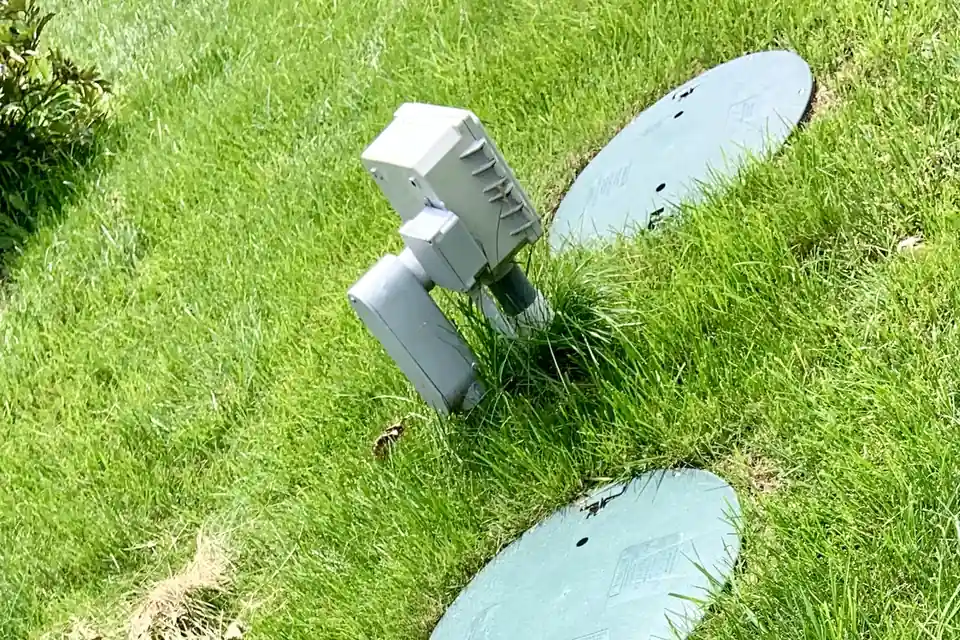
First confirm the property actually uses an onsite system
A Huntsville, Madison, Harvest or other Madison County address does not by itself prove that the property uses septic. Public sanitary sewer serves many properties, while onsite systems remain in other areas. Before treating a backup or drainage problem as a septic-field failure, confirm the property's wastewater service and look for any existing onsite permit, system drawing or Approval for Use record that may help the evaluator understand what is installed.
Warning signs worth documenting without diagnosing the cause
What else can cause similar symptoms?
Do not assume a disposal field needs replacement from one symptom. An onsite evaluation may need to distinguish among an overdue pump-out, indoor plumbing blockage, damaged inlet/outlet piping, baffle or distribution problem, pump/control failure, tank damage, field-line damage, disposal-field failure, site drainage conditions or an advanced-system component issue.
Madison County Rules & Repair Options
Repair, field-line work, disposal-field replacement or full system replacement?
| Project path | When it may enter the discussion |
|---|---|
| Component or line repair | A specific pipe, baffle, distribution, pump, control or tank component is the primary failure and an approved repair addresses it. |
| Field-line repair or partial field work | A defined portion of the disposal system can be corrected and the proposed work fits the site's records, evaluation and health-department requirements. |
| Disposal-field replacement | The existing absorption area no longer functions reliably and a suitable approved replacement solution is available. |
| Advanced or engineered system work | Site constraints, system type, flow, treatment method or the existing design requires a provider and possibly a designer/engineer with the appropriate capability. |
| Full system replacement | Multiple components, tank condition, site limitations or the approved redesign make broader replacement the practical path. |
The useful question for estimates is not simply “How much is a new septic system?” Ask each evaluator what evidence supports the proposed scope, what can remain, what must change, and which permit/design/inspection steps are included.
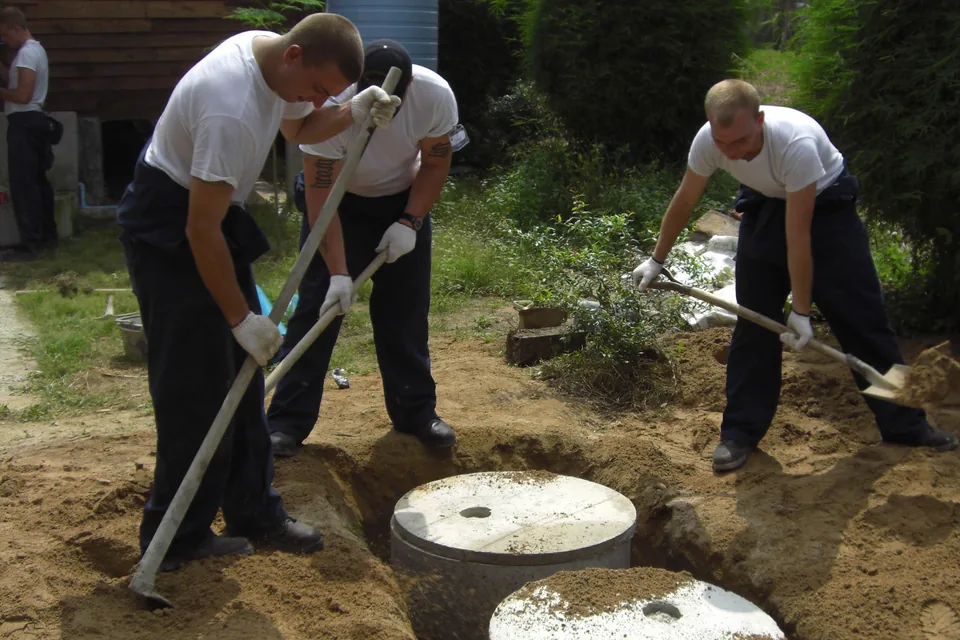
Madison County repair permit and Approval for Use
Madison County Health Department currently states that Alabama law requires homeowners and businesses not connected to a public sanitary sewer to obtain a permit from the local health department before installing a new onsite system or making repairs to an existing one. The county also describes health-department inspection and issuance of an Approval for Use before a building can be occupied.
ADPH's Soil and Onsite Sewage Branch maintains a statewide repair protocol intended to verify that septic-system repairs are completed properly. Its forms page includes current permit-to-install/repair forms for small-flow and large-flow onsite systems. The exact documents and evaluation needed depend on the property and proposed work.
Alabama license categories are not interchangeable
The Alabama Onsite Wastewater Board licenses people working in the onsite-wastewater industry and publishes a searchable current roster. Its FAQ defines different scopes for Basic installers, Advanced Level I installers, Advanced Level II installers and pumpers.
| Current AOWB category | Homeowner relevance |
|---|---|
| Basic Level Installer | Published scope covers specified conventional and shallow-placement onsite systems up to the Board's stated flow limit, including specified service and repair work. |
| Advanced Level I Installer | Adds specified mound, timed-dose/duplex and secondary-treatment system work within the Board's published Level I scope. |
| Advanced Level II Installer | Adds larger-flow and additional advanced-technology system work within the Board's published Level II scope. |
| Pumper | Published scope centers on pumping/servicing and specified septic-tank component work; a pumper credential alone should not be assumed to cover every disposal-field or advanced-system project. |
Verify the current roster entry for the person or company responsible for the work and confirm that the proposed system and repair fall within the relevant license scope.
Cost
Major septic work is not one price category. In Madison County, the failed component, existing system records, disposal area, soil/site evaluation, conventional versus advanced technology, health-department repair approval, excavation and restoration can all change the scope. The ranges below are planning evidence, not a diagnosis or quote.
| Planning scope | Current planning range | How to use it |
|---|---|---|
| Distribution-box replacement context | $500–$1,500 | 2026 component benchmark; not a drain-field replacement price. |
| Drain-field repair / rejuvenation | $1,000–$5,000 | 2026 planning band when the approved solution is repair rather than replacement. |
| Conventional drain-field replacement | $3,000–$15,000 | 2026 field-replacement planning band before property-specific design, access and restoration. |
| Madison-area conventional full-system cross-check | $4,000–$12,000 | One current local contractor's published installed range for conventional systems; a cross-check, not a market average. |
| Madison-area alternative-system cross-check | $8,000–$20,000 | One current local contractor's published range for alternative systems; actual approved technology controls the scope. |
| Engineered / unusually constrained system context | $7,000–$20,000+, sometimes around $25,000 | 2026 planning context for more complex sites/systems; not an automatic Madison County price. |
Worked field-line arithmetic
Current 2026 planning evidence places field-line replacement around $20–$45 per linear foot. If an approved repair actually involved 100 linear feet of field line, that arithmetic is about $2,000–$4,500; 150 linear feet is about $3,000–$6,750. Those examples do not include every tank, design, excavation, permit, disposal-area or restoration cost and do not determine how much field line a property needs.
| Illustrative approved field-line scope | 2026 unit context | Arithmetic only |
|---|---|---|
| 100 linear feet | $20–$45 per linear foot | $2,000–$4,500 |
| 150 linear feet | $20–$45 per linear foot | $3,000–$6,750 |
What can move a Madison County quote
| Cost driver | Why it matters |
|---|---|
| What actually failed | A distribution component, pump or line repair is fundamentally different from replacing the disposal field or full system. |
| Existing records and disposal area | Permit drawings, design flow and remaining suitable replacement area can change what the health department can approve. |
| Conventional versus advanced technology | Dosing, treatment and other advanced-system components can change equipment, design and installer-license requirements. |
| Site evaluation / design | Soil/site conditions and the approved repair protocol can require additional evaluation or professional design. |
| Access and restoration | Utilities, trees, slopes, hardscape, hauling, grading and finish restoration can materially change construction cost. |
Planning evidence reviewed August 17, 2026. The broad repair/field/system ranges are cross-checked against current 2026 HomeGuide and Angi data. The $4,000–$12,000 conventional and $8,000–$20,000 alternative figures are one current Madison-area contractor's published ranges and are labeled only as local cross-checks. These are independent planning figures, not Ikard Septic Tanks prices. No calculator is shown because a homeowner-entered quantity cannot determine the approved septic repair or system design.
Find & Compare Contractors
Match the provider to the work—not just the word “septic”
| Need | What to verify |
|---|---|
| Routine tank pumping / tank service | Current pumper credential and service fit. |
| Conventional system repair or installation | Current installer credential, exact repair/installation scope and territory. |
| Advanced system repair/replacement | Current Advanced installer category that matches the system and proposed work. |
| Site evaluation / design | Who performs the required evaluation/design and whether a registered site professional or engineer is needed. |
| Excavation / restoration | Who owns site preparation, utility coordination, hauling, grading and finish restoration. |
Local provider comparison options
Use these neutral comparison providers as starting points. Confirm current service territory, exact septic repair/replacement capability, current onsite-system installer or pumper credentials where applicable, insurance, availability, permit responsibility and written scope directly.
Tony Ikard Septic Solutions
Separate Harvest-area business whose current site advertises septic installation, repairs, inspections, maintenance and excavation for Madison and Limestone counties.
Cora Environmental
Huntsville-based provider whose current site lists drain-field installation, repair/replacement, septic repairs, inspections and related wastewater services across North Alabama.
Bailey's Septic Service LLC
Current site lists septic installation, system repair and field-line services and identifies Huntsville and Madison County within its service area.
McNeese Septic & Excavation
Huntsville provider whose current site advertises septic installation, repairs, drain-field restoration and excavation, with Madison County communities listed in its service area.
J Henry Plumbing
Broader Huntsville plumbing provider whose current septic page lists system installation/removal/repairs, new and repaired field lines, new tank installation and pump replacement.
Comparison listings are not ranked or endorsed. Provider information can change, so verify current facts before hiring.
Compare estimates on the same questions
- What component or area appears to have failed, and what onsite findings support that conclusion?
- Were routine pumping, indoor plumbing blockages and simpler component failures considered before recommending field replacement?
- What existing permit, Approval for Use or system drawing was found for the property?
- Who is responsible for the Madison County repair permit, site evaluation, design and required inspections?
- What AOWB license category will be responsible for the onsite-system work, and how does it match this system?
- Does the proposal repair a component, repair field lines, replace the disposal field, or replace/redesign the full system?
- What excavation, hauling, utility coordination, grading and restoration are included?
- What changes if the expected replacement area or existing design cannot be used?
- What workmanship, equipment or system warranties are included in writing?
Frequently Asked Questions
What does major septic repair or replacement cost in Madison County?
Current planning evidence separates component work from drain-field and full-system scope. A distribution-box replacement may be roughly $500–$1,500, drain-field repair or rejuvenation about $1,000–$5,000, and conventional drain-field replacement about $3,000–$15,000. A current Madison-area contractor publishes $4,000–$12,000 for conventional full-system installation and $8,000–$20,000 for alternative systems as local cross-checks, not market averages.
Do septic repairs require a permit in Madison County?
For properties not connected to public sanitary sewer, Madison County Health Department currently says a local health-department permit is required before repairs are made to an existing onsite system. Confirm the current process for the property and scope.
Does every Huntsville-area property use septic?
No. Confirm whether the property is served by public sanitary sewer or an onsite system before treating a backup or drainage issue as a septic-field problem.
Does a backup or slow drain prove the field failed?
No. Plumbing, tank, piping, distribution, pump/control and disposal-field problems can overlap. An onsite evaluation is needed.
Can a drain field be repaired instead of replaced?
Sometimes. It depends on the failed component, existing system, site evaluation, suitable disposal area and the repair the health department approves.
What is the difference between Basic and Advanced installers?
AOWB publishes different installer scopes. Advanced Level I and II categories add specified system types and complexity beyond the Basic license. Verify the current roster and make sure the license category matches the proposed system and work.
How do I verify an Alabama onsite-wastewater license?
Use the Alabama Onsite Wastewater Board's current roster search and confirm the exact license holder and category responsible for the job.
Are the other providers ranked?
No. They are neutral comparison starting points based on current public service information. Home Problems Guide does not rank or endorse standard comparison listings.
Want to learn more?
Madison County Health Department — Environmental Services
Check the county's current onsite-sewage permit and inspection guidance.
ADPH — Soil and Onsite Sewage
Review the state's onsite-sewage program and current repair protocol.
ADPH — Onsite forms
Find current repair/install applications and related onsite-system forms.
Alabama Onsite Wastewater Board — License roster
Verify current installer, advanced-installer and pumper credentials.
Alabama Onsite Wastewater Board — License FAQ
Compare the Board's published scopes for Basic, Advanced Level I, Advanced Level II and pumper licenses.