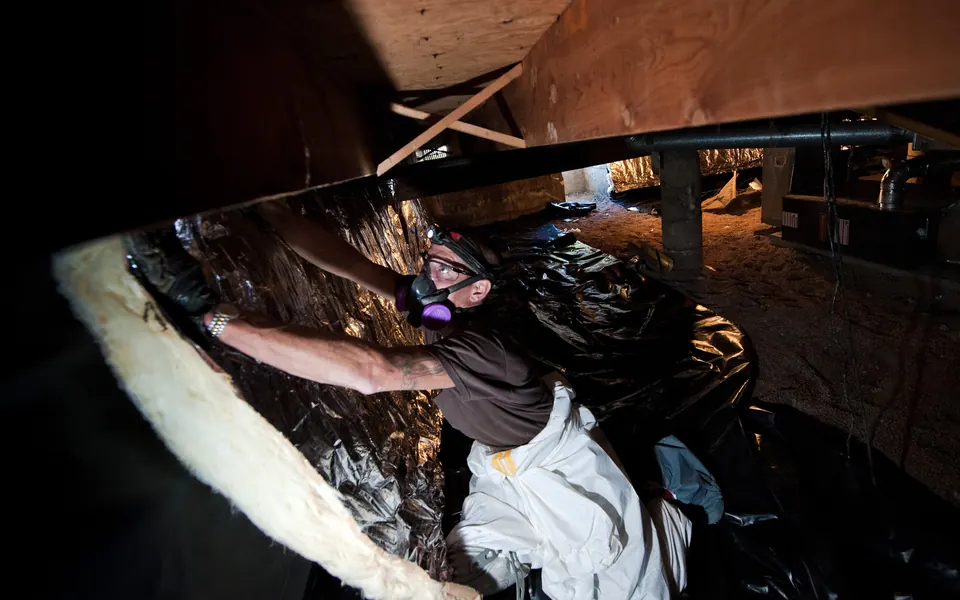
A vapor barrier and full crawl-space encapsulation overlap, but they are not necessarily the same project. The correct scope depends on active water entry, ground moisture, air leakage, humidity, drainage, existing damage, and how the space is intended to perform.
| Approach | Typical purpose |
|---|---|
| Ground vapor barrier | Covers exposed earth to reduce water vapor moving from soil into the crawl space. Detailing, seams, penetrations, and wall coverage matter. |
| Drainage / bulk-water correction | Addresses standing water, runoff, groundwater, downspouts, grading, or another source that should not simply be trapped beneath a liner. |
| Encapsulation / sealed crawl space | Uses a more continuous liner and air/moisture-control strategy, often with sealed vents or openings and planned humidity control. |
| Dehumidification | Helps control air moisture after the major water and vapor sources have been considered. |
| Structural repair | Addresses damaged joists, sills, supports, or floors when moisture has already contributed to material deterioration. |
Questions to ask before paying for encapsulation
- Is there active standing water or a drainage problem that should be corrected first?
- What areas will the liner cover, and how will seams, walls, piers, and penetrations be sealed?
- How will humidity be monitored or controlled after the work?
- Are damaged wood, insulation, plumbing leaks, pests, or structural problems part of the scope or separate?
- What maintenance does the system require?
Find the local version of this guide
Local pages add county or market-specific conditions, public-process context, and independent provider options.
Buncombe County / Asheville
Asheville and Buncombe crawl-space moisture, encapsulation questions, local conditions, and independent providers.
Haywood County / Waynesville
Waynesville, Maggie Valley, Canton and Haywood crawl-space moisture and encapsulation guidance.
Henderson County / Hendersonville
Hendersonville, Flat Rock, Fletcher and Henderson County crawl-space moisture and provider research.
Want to learn more?
These practical and official resources can help you understand the issue and prepare better questions before hiring.
DOE: crawl-space capillary break and ground cover
See why ground vapor control and bulk-water drainage are treated together.
Official resource ↗DOE: crawl-space vapor-retarder job aid
Review federal installation guidance for crawl-space vapor retarders.
Official resource ↗EPA: ways to control moisture in a home
Review practical steps for ground moisture, ventilation and humidity control.
Official resource ↗